Monday, June 27, 2011

Hungary & Croatia -- Day 4

Despite not going to sleep until after midnight, I awoke at 5 a.m. Not able to get back to sleep, I got up at 6 a.m. (!!) and went to the lobby to download yesterday’s pictures onto the computer and check e-mail. When breakfast began being served at 7 a.m., I participated and then went back to the room to pack. Luggage to the bus at 8:30 for a 9 a.m. departure, which we actually made.

Today was mostly driving – a very long day on the bus. So it’s appropriate to show a picture of the bus here. They’re really nice vehicles but spending 7 hours on it today tested my patience.

One and a quarter of those hours were spent sitting at the Croatian border. Since there were no other buses behind us, the crossing guards did their diligent job, collecting and checking individual passports. Ah, well. . . .

We arrived at Delnice at 4:30, were greeted by the Delnice brass band,

and then given an aperitif of the area’s famed blueberry liqueur. It was actually quite good.

The Star of the North concert is part of the celebration of the city’s parks and of the local band’s 100th anniversary. There were a number of activities ongoing. A miniature “4-H” exhibit showed rabbits, chickens, pigeons, and goats. At the rabbit exhibit I met 11 year old Paula and her 12 year old friend Matea who were showing animals. They spoke a little English and seemed to like following me around.


People were selling local crafts and the blueberry liqueur. Rides in a horse-drawn cart were provided to children who also were playing on the park playground equipment while the adults listened to the variety of entertainment provided on the bandstand. The setting was a GORGEOUS park with wonderful tall trees. All in all a fun event.

Later Paula, Matea, and I were joined by 8-year old Marianne. Here are the four of us "good buddies" and a picture of Paula with the Star of the North pin I gave her.

I promised Paula I would put the pictures on my Facebook page. Guess she’ll figure out how to get there.

The concert went well. For some reason (the concrete underfoot, the trees above), the acoustics were quite good for an outdoor concert where people are standing on all sides of the band. And the setting was quite lovely.

When the concert was over, dinner was provided in the hotel, a buffet with a variety of food. Socializing lasted until 9:30 when the bus took us to the neighboring town of Fuzine where we were put up in a large hotel and four smaller guest houses. It looks like a charming town; hope we get a little time to explore.

Hungary & Croatia -- Day 3

Slept well, and long, last night. Alarm didn’t wake me so Helen had to. It’s nice, feeling really refreshed.

The new bus arrived along with Helmut, our new bus driver. Loaded everything up and were on the road at 9:10 a.m. We made only one fast pit stop but were still late for our appointment with the Budapest city guide. It seems as if most of our bus journeys are taking longer than planned.


The local guide accompanied us for a two-hour tour of Buda, named after the brother of 5th century ruler Attila, and Pest, which means flat – and it is. Buda is larger, having 17 of the 23 city districts, while Pest has only 6. The entire city is approximately 520 square kilometers. Our guide said that all of the bridges across the Danube River were destroyed by the Nazis during World War II. Many of the bridges we saw are built in an earlier 19th century style so either were not destroyed or were rebuilt to earlier plans. A question to research. . . .


There are many lovely and impressive buildings, including the Royal Palace. The Palace has had many incarnations. There is reference to building a castle in 1255, but that might have been at a different place. About 1400 Sigismund of Luxembourg built a Gothic palace on the site. When the Turks captured Buda in 1541, the palace was used to stable horses. Eventually it fell into ruins until 1719 when a small palace was built on those ruins. That was expanded upon by Marie Theresa who, in 1749, built a vast palace of 203 rooms. That complex was destroyed in 1849 by Hungarian insurgents. In 1891 rebuilding began with construction completed in 1905. That is largely the Palace seen today.


The Parliament building was built in 1904 in neo-Gothic style. It is HUGE, its 698 rooms way beyond what is necessary for legislative needs. Indeed, it has two large wings, each for one of the two houses of government. Unfortunately, the government is now unicameral rendering one wing immediately obsolete. But from the outside, particularly the view from the Danube, it is quite beautiful and impressive.


The city is lovely with a number of parks and squares and tree-lined streets. Andrassy Avenue is 2½ kilometers long and has many lovely homes along it. In the 19th century the street was made of wood so the noise of the horses’ hooves wouldn’t disturb the residents as streets made of stone might do. Budapest appears to utilize the Danube to enhance the livability of the city. I don’t know whether the river was ever primarily used for industry, but it certainly isn’t now. The Danube is the second largest river in Europe and flows through ten countries.


We drove almost to the top of Gellert Hill and exited the bus so we could see the “most beautiful view” in Budapest – looking down at the river and the city from the high point of the Citadel. Helen and I positioned ourselves for the obligatory photograph.

A piece of trivia: Gellert hill was named after St. Gellert, a Benedictine monk who was born around 980. He taught the son of King St. Stephen, who subsequently made him a bishop. He was killed in 1046 during a pagan revolt by being sealed in a barrel and thrown off the hill which now bears his name.

The Citadel is a Hapsburg fortress built in the 1850’s but never really used for military purposes. Since 1960 it has served as a leisure complex. At the top of Gellert Hill looking out over the city is Liberation Monument, a statue which the guide referred to as “lady liberty.” The monument commemorates liberation of Budapest by the Russian army. It is a woman on a pedestal which reaches 46 feet. After the fall of Communism, a figure of a Russian soldier at the base was moved elsewhere. Here’s one picture, taken upward from the base, and a second taken from a boat out on the river.


The tour finished and our hotel rooms now available, we went to the hotel to check in. There were a few glitches with which the beleaguered trip leader had to deal. Among the problems was Helen’s and my room which had a double bed instead of the requested twins. We were able to do a switch, and the other difficulties were resolved as well, but it all took time and energy.

Once we were established in our new room, Helen and I walked to Patriot or Heroes Square, just a few blocks from the hotel. She went to the adjacent art museum while I wandered around the square. It was built in 1896 as a millennium celebration of the founding of Hungary by seven chieftains who came to the area from Asia. Each chieftain is represented by an equestrian statue. Many improvements were made in Budapest during the Millennium Celebration as the city underwent major modernization.


There was a lot of activity on the square this late Saturday afternoon because of the T-Mobile-sponsored concert which was to take place later in the evening just two blocks away. Between the square and the concert stage vendors were setting up to be prepared for the crowds. The concert apparently was to celebrate something to do with the European Community. Not speaking or reading Hungarian made it difficult to figure out what was happening, but rock music being broadcast at ear-splitting level gave a hint.


From Patriot Square I walked into and through the adjacent park, Varosliget. Supposedly there is a zoo there, but I never found an entrance (although later saw its location on a map.) Did discover a fascinating art installation in the large pond next to the modern art building. There was a display of pictures showing that the pond had been drained for construction and placement of the pieces. I took a photo of the photograph.

While I’m not sure these items are “art,” they were fun to look at, which many people were doing. Because I was fascinated, I took a lot of pictures. In the background (of the outhouse "art") is Vajdahunyad Castle, not really a castle but a complex of buildings constructed in the 20th century in different architectural styles.


Since it was after 5 p.m. by the time I finished seeing all the outdoor art, I hurried back to the hotel to get ready to go to dinner. Six of our group of 64 had decided to do a dinner river cruise on the Danube. I strongly felt that if I were in a city on the Danube, I should spend some amount of time on the river.

While waiting the hour+ between check-in and the cruise, we walked to St. Stephen’s Basilica, window shopping and taking in various sights along the way, including a fun statue of a policeman which begged for a picture and a segway tour just starting from the square.


The construction of the Basilica began in 1851 and was completed in 1905. It is dedicated to St. Stephen (or Istvan), the first Hungarian Christian King. He was born in 975 and baptized at age 10. In 1000 he was crowned the Catholic King of Hungary and worked to spread Christianity. He died in 1038 and was canonized in1083 by Pope Gregory VII.

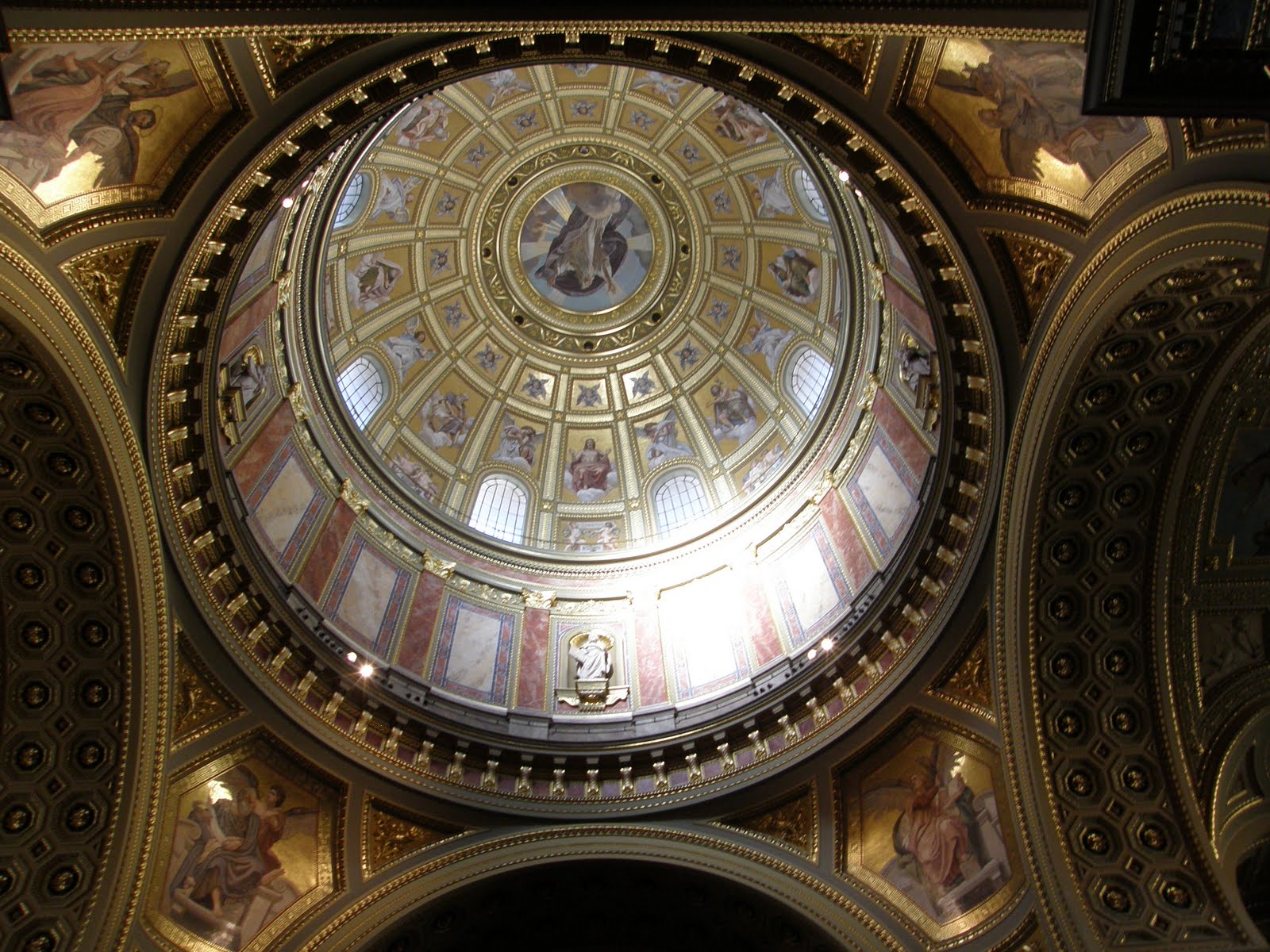
The dome of the basilica stands 315 feet high and dominates the city. The interior is quite ornate with a statue of St. Stephen in the middle of the altar, and the interior of the dome is impressive. After briefly seeing the church, it was time to return to the ship’s office to get on the cruise.


The food on the dinner cruise was fine and the scenery interesting, so it was a worthwhile effort. And a 3-piece “gypsy” orchestra played, a little hokey perhaps but good fun. From the boat we saw many of the interesting buildings we’d previously observed, just from a slightly different angle.


From the river it is easy to see how Gellert Hill dominates the view. On its south slope is a grotto church based on Lourdes, which was built in 1926. Sealed in the 1950s by the Communist authorities, it was reopened in 1989. This photo, taken at dusk, is not the greatest.


The cruise ended at 9 p.m.. We'd hoped to see the city lit up for night, but we were a little early. The lights on this bridge came on just as we got off the boat.

After returning to the hotel. I got a cup of coffee, finished my journal, and wrote a postcard. Then I completed the blog entry for the previous day’s activities and posted it. It was very frustrating since the post showed several paragraphs appearing in a different typeface. I would return to edit, change the typeface, and post only to find the typeface for a different paragraph had changed. It seemed to be random with no reason apparent to me. There was one paragraph for which I corrected the typeface at least five times. The entre blog finally appeared to be correct, and I got to bed about midnight. I DO wish I understood what was happening and why. . . .


P. S. A Fun Fact (as David Letterman would say): Information picked up during the guided tour. The population of Hungary is 70% Roman Catholic, 20% Protestant, and 10% other. It does boast the 2nd largest synagogue in the world (the largest being in New York City). The synagogue was built in 1854-9 and has 3 naves which can accommodate up to 3,000 worshippers.

Saturday, June 25, 2011

Hungary & Croatia -- Day 2

Headed off on the bus at 9:50 a.m. for a bit of touring. Three members of the local Hungarian band joined us to provide directions; they promised a “surprise” at some point in the day about which our leaders knew nothing.

After driving through some lovely countryside (lots of corn and sunflower fields) and attractive villages (many red tile roofs), we arrived at the Archabbey Pannonhalma.

Benedictine monks have lived on this site since 996 when Geza, Prince of Hungary, settled a religious group from Bohemia on the Hill of Pannonia, already seen as sacred. The monastery’s charter was confirmed by King Saint Stephen, who is both a secular and religious figure in Hungary. The hill and the abbey dominate the surrounding countryside, and the view from the top is quite lovely.

The religious community originally held large tracts of land, both in the area and in the southern part of the country, but those were confiscated by the communist government after WWII. The monks bought back some of the land directly around the abbey after the end of communism in Hungary and are involved in grape growing and wine making. However, the monks’ primary work now is secondary education, operating a boy’s boarding school on the abbey grounds and another, coeducational, school in Gyor. The community now has about 50 monks, the same number which the communist government allowed during the Soviet era. Since those men are now old and dying, the total number of monks has not increased despite recent recruitment.

The abbey church, third building on the site, was completed in the 13th century. It is late Romanesque-early Gothic architecture, built at the time of King Matthias. Like most medieval buildings, it was changed and added to over the years.

During the time of the Ottoman Empire the conquering Turks used it for a mosque which actually helped preserve it since the structure was treated well, although all the furnishings were destroyed. Also, removed or damaged were any depictions of humans such as these faces found in the crypt area. Apparently destroying the noses made them no longer human so no further removal was necessary. After the Turks left, the restorer repaired the noses in a different stone so it would be clear what the occupiers had done.


The library is quite impressive. According to our guide, it is the 3rd largest library in Hungary and the largest Benedictine library in the world. The guide was aware of the project by St. John’s Abbey in Collegeville, Minnesota, to digitize monastic manuscripts worldwide, noting that representatives had come to Pannonhalma to copy documents.

We walked down from the library to the visitor center and our bus to go to the nearby restaurant for lunch. After a long lunch we boarded the bus to return, I thought, to the hotel where I’d hoped I might be able to use the spa facilities. Instead we had our Hungarian surprise, which turned out to be very nice.

Leslie, one of the Hungarian band members who spoke excellent English, had made arrangements with Uncle Paul (never did determine if Paul was actually his uncle) to visit the family winery. It’s quite small, serving the immediate community. I’m not sure if they even have bottling facilities. The wine, using Italian-style grapes, was good – both the red and white were mild and dry. The peach schnapps was a little harsh, but it’s growing on me. We spent almost two hours enjoying the wine and the company which was great – but meant no time for the spa.


By the time we got back to the hotel, it was almost time to leave for the concert.
I did get in 25 minutes of nap time, but then we were back on the bus heading for the park where the Voluta Festival was being held. There was a bit of a glitch as the bus got stuck in a mud hole on the drive through the field to get closer to the festival. We walked the rest of the way, and the bus driver was able to get the bus out with the help of some of the locals.The Voluta is the river which runs through Mosonmagyarovar. There was food to buy including some yummy marzipan bonbons, entertainment for the kids, lots of drinking, and entertainment. The younger crowd was awaiting the rock music which followed the two bands, but the older folk and kids seemed to enjoy the bands.


The Hungarian band played for about half an hour looking really spiffy in their red uniforms. Then Star of the North played for 40 minutes. The concert ended with two rousing marches, a Hungarian one and, of course, Stars and Stripes Forever which were both played by the two bands together. Quite fun.

There was to be a gathering of the two bands with food after the concert. Helen and I opted out, deciding we’d rather return to the hotel and have the chance for a bit more sleep. I grabbed a gyros at one of the food stands as we left (along with about 8 others who decided to forgo the reception) and ate it on the bus returning to the hotel. It was definitely the right decision as I was able to get to bed before midnight.

Thursday, June 23, 2011

Hungary & Croatia -- Travel and Day One

Wednesday Helen and I arrived at the Minneapolis-St. Paul airport about 11 a.m. and started on our travels with a 12:40 flight to Chicago. A few of the Star of the North Band group were on our plane; many others had left earlier and met us as we all boarded the Lufthansa flight to Dusseldorf which left at 5:10 p.m. arriving on Thursday about 8 a.m. German time, about 20 minutes late. Had to rush to the next flight which left almost 15 minutes late, arriving in Vienna about 10:30 a.m.

There we gathered on our double-decker bus pulling a trailer filled with luggage. There are 55 of us currently, to be joined in two days by 5 others who took a different route and were held up by thunderstorms in Detroit overnight. This is a "temporary" bus since the one we were supposed to have had air conditioning problems; in Budapest we'll get the permanent bus and driver (all going well).

The bus left the airport at 11, heading for downtown Vienna and a tour of the city led by a guide who joined us for that purpose. We spent about 2 1/2 hours driving around the older part of the city, stopping at a couple of places for a better look, but still a rather perfunctory tour. Since we were in the city for the purposes of plane arrival, I'm glad we had the opportunity for a little sightseeing anyway.

Stopped at the Hundertwasser House. Friedrich Hundertwasser was an artist who abhorred straight lines as evidenced by buildings he had constructed.

He also saw no need for windows to be similar much less identical (as evidenced above) and thought that trees as well as people should "rent" apartments.


Definitely eccentric -- perhaps a trifle crazy? . . .


We saw what our guide called the "ferry" wheel built in 1898 by Emperor Franz Joseph. It has only half the "cabinets" (cars) of the original. Looks to me like an early prototype of the London Eye. I would have loved to have had the chance to ride on it. . . . No time.


We then drove out to a "far" neighborhood of the city where in the late 17th century Prince Eugene built a summer palace to which to retreat from the winter palace in the center of the city. A quite impressive summer place.

The building now houses a museum, its most famous piece of art being Klimt's The Kiss.

We drove by and over the Danube River several times on our bus tour. Not that blue, or beautiful, but still a nice river with lovely waterfront.


And there were some interesting uses along the way, including this swimming pool on a barge which we were told is used quite a bit by downtown workers to get some exercise.


Having finished our tour we returned to the airport to pick up some, unfortunately not all, lost luggage (mine arrived with me just fine) and then begin the drive to Hungary. It took a little over an hour to reach our destination; the border crossing was a breeze with the bus waved on through with no one checking our passports.

Arrived in Mosonhmagyarovar, Hungary, (no, I don't know how to pronounce it) a little before 5 p.m. and checked into the Hotel Thermal. There are hot thermal springs here; don't know if we'll have time to participate. Had a group dinner at 7:30 and then I retired to my room to catch up on e-mails and write this. There's a great, free, wi-fi connection in the room.

Off to bed now. Hope a good night's sleep cures jet lag.


Sunday, June 19, 2011

Hungary and Croatia -- soon

Tomorrow I'll be leaving for an almost 2-week trip to Hungary and Croatia. I am going along as a "groupie" with Helen, a friend from church, and her community band, Star of the North. Every two years the band does an overseas trip; several years ago I accompanied them to Thailand.

In addition to some of the usual tourist activities, we have the opportunity to meet locals as the band plays concerts along the way, often in conjunction with local bands. That gives a different perspective to a foreign trip.

We'll be flying into Vienna, moving quickly on to Budapest, traveling a bit in Hungary, spending most of our time in Croatia, and returning to the U.S. from Dubrovnik on July 5. Below is a map which follows the journey (in yellow marker).


I hope that I'll have the time, and decent internet connections, to blog along the way. So keep checking. Must now finish packing.